


SUNDRAW S1 Solar Power Bank
SUNDRAW S1 Solar Power Bank
🔋 20,000mAh Cell · About 5 Full Phone Charges
☀️ Solar Keeps It Topped Up
🔌 4 Cables Built In
📶 Qi Wireless Pad
🔦 Dual LED Camping Light
💧 Waterproof Housing
✈️ 74Wh, Carry-On Legal


PICK YOUR PACK
Couldn't load pickup availability
🛡️ 90-Day Money-Back Guarantee
✈️ 74Wh, Cleared For Carry-On
🎖️ Veteran Owned & Operated
- American express payment method
- Apple pay payment method
- Bancontact payment method
- Google pay payment method
- Master payment method
- Paypal payment method
- Shopify pay payment method
- Unionpay payment method
- Visa payment method
-
Ordered
- - -
Order Ready
- - -
Delivered

SUNDRAW S1 Solar Power Bank
See It In Action
Most power banks get bought once and opened twice. The first time is the day it arrives. The second is the night the power goes out.
Here is what that second night actually looks like.
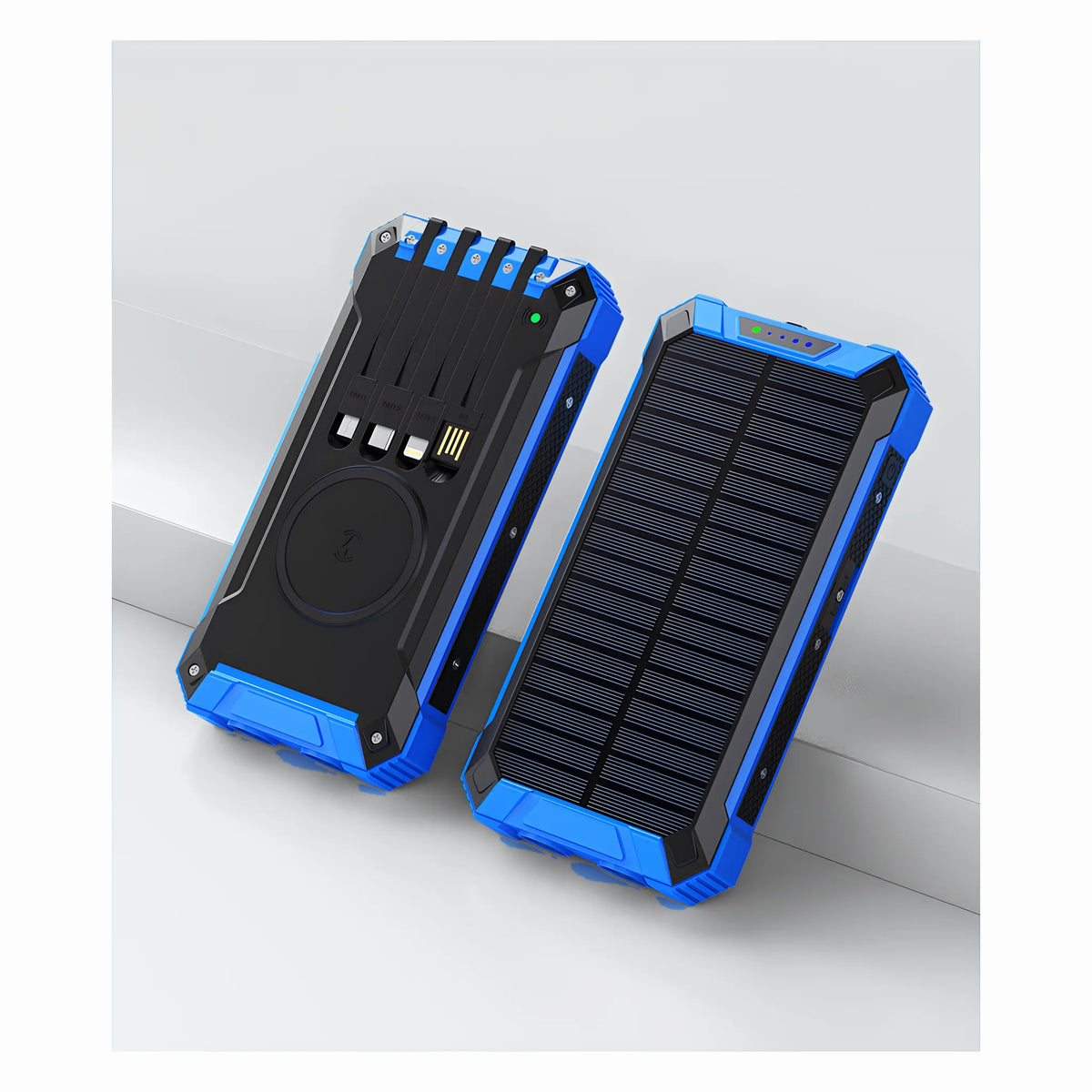
You pick it up and four lights on the front tell you where it stands, without plugging anything in to find out. The cable your phone takes is already strapped to the side, so the phone is charging about four seconds after you reach the drawer. The button on the edge turns on two LED panels, and the hallway stops being a place you feel your way through. Your partner's phone goes face down on the pad on top, no cable at all. Your kid's tablet takes one of the USB ports.
In the morning it goes on the windowsill, panel up, and starts pulling back what the night cost you.
Specifications
Specifications
Product Name: SUNDRAW S1 Solar Power Bank
Cell Capacity: 20,000mAh (74Wh) at 3.7V
Rated Output: 13,000mAh (65Wh) at 5V
Typical Phone Charges: About 5 full charges
Conversion Efficiency: Approximately 88 percent
Max Output: 10W
Charging Protocol: QC2.0
Input: 5V
Wireless Output: 5W (Qi)
Built-In Cables: 4 (USB-A, Micro USB, USB-C, Lightning)
Additional Ports: Multiple USB outputs
Solar Panel: Integrated, maintenance top-up
Light: Dual LED panel
Battery Display: 4-LED indicator
Cell Type: Polymer lithium-ion
Protection: 9 circuits including over-voltage, over-current, short-circuit and over-discharge
Shell: Impact-resistant plastic, waterproof housing
Dimensions: 173 x 89 x 28 mm
Weight: 420 g
Air Travel: 74Wh, under the 100Wh carry-on limit
Colors: Orange/Black, Red/Black, Green/Black, Blue/Black
Returns: 90-day money-back guarantee.



Why the Battery in Your Drawer Was Already Empty
Here is the part nobody tells you when you buy an emergency power bank.
Lithium cells leak charge just by sitting there. Not fast, and not visibly. A little every week, quietly, for as long as the thing sits in a drawer or a go-bag. There is no warning light for it. Nothing beeps. The battery simply arrives at the moment you need it with far less in it than the day you put it away.
So you did not forget. You were never given a way to remember.
That is the real design flaw in almost every power bank sold as emergency gear: it was engineered for a day out, not for a year of waiting. Buying a second one does not fix it, because now two batteries are draining instead of one. Buying a bigger one does not fix it either. Neither does buying a better brand.
The only thing that fixes it is a way for the battery to put charge back without you, and without the grid.
That is what the panel on the back is for. On a windowsill, on a dashboard, clipped to a pack, it puts back what sitting still takes away. So the number you see in eight months is close to the number you left.

Two Numbers on the Label, Not One
Almost every power bank prints one capacity number. We print two, because two is the honest answer.
20,000mAh is the cell. That is what the battery holds inside, measured at 3.7 volts. It works out to 74 watt-hours.
13,000mAh is what comes out of the port. Your phone charges at 5 volts, not 3.7, and stepping the voltage up costs energy. About 12 percent of it. Run the math and 74 watt-hours becomes 65, which at 5 volts is 13,000mAh.
Both numbers describe the same battery. The first is what it holds. The second is what reaches your phone.
Thirteen thousand milliamp-hours is roughly five full charges for a modern phone. Not "up to." Five.
If you own a USB power meter, we would genuinely rather you use it. Plug it in, drain it, and hold us to the number. That is the whole point of printing it.
One more number that matters: 74 watt-hours is under the 100 watt-hour ceiling airlines set for carry-on batteries. This one flies with you.

Built For The Second Night
-

Four Cables Built In
USB-A, Micro USB, USB-C and Lightning are already attached to the body on their own straps. There is no bag to dig through and no cord that turns out to be the broken one. Plug the phone straight into the thing you just picked up.
-

One Unit, Every Phone
Multiple outputs plus a wireless pad means your phone, your partner's and your kid's tablet come off the same battery instead of taking turns. Thirteen thousand milliamp-hours goes further when nobody is rationing it.
-

Light You Can Walk By
Two LED panels on the side, not a pinhole torch on a phone you are trying to preserve. Enough to find the breaker box, read a label, or keep a room from feeling like a cave.
-

Nine Protection Circuits
Over-voltage, over-current, short-circuit and over-discharge protection, plus five more. The battery that sits quietly for months is the same one that behaves the night you load it up.


Ready vs. In the Dark
The same night, two very different mornings.
With the SUNDRAW S1
- Sun puts charge back while it sits, so the number holds
- Two numbers on the label, both of them true
- Four cables already attached, nothing to hunt for
- Wireless pad for the phone that has no port left
- Two LED panels that light a room, not a keyhole
- Waterproof housing, so rain is just weather
- Charges the family's phones off one unit
- 74Wh, cleared for carry-on
Without it
- Eight months of quiet self-discharge, discovered at the worst moment
- One inflated number and no way to check it
- A drawer full of cords, none of them the right one
- Everyone negotiating over the last working cable
- A phone torch eating the battery you are trying to save
- A battery you have to keep dry and think about
- One phone at a time, and a queue behind it
- Left guessing whether it can even fly
Still Full When They Reached For It
-

Got it in March and I have not plugged it into the wall since June. It lives on the sill over the kitchen sink, panel facing out, and every time I pick it up all four lights are lit. That is the entire reason I bought it. The last two banks I owned were dead in the drawer when I finally needed them and I never could figure out whose fault that was.
-

Road trip from Ohio to Montana with two kids in the back. Between the ports and the pad, everybody stayed charged without me running a spider web of cords off the cigarette lighter. Threw it on the dash at lunch stops and it gained a little back each time.
-

Charged my phone from 4 percent to full and still had three lights showing. Did that four more times over the next week without recharging it. About what they claim, which surprised me.
-

Bought it for my daughter at college in a town that loses power constantly in the winter. She used it during a two day outage in February to keep her phone and her roommate's phone going and she said it was the only thing in the dorm that worked.
-

Wildfire evac bag item. It has been in there since April and I have pulled it out twice to check. Both times four lights. I do not have to schedule a reminder to maintain the thing, which was my whole problem before.
-

Charged my phone, my daughter's phone, and my husband's watch over a weekend at a cabin with no power. Still had juice. Left it on a rock in the sun each afternoon which slowed the drop.
-

I run a small farm and the power goes out here whenever it feels like it. This has been sitting on the shelf in the mudroom since January and it has never been below three lights when I checked.


90 Days to Decide
Charge it. Drain it. Meter it. Leave it on a shelf for two months and come back to it.
If it does not hold up the way we said it would, send it back inside 90 days and we will refund it. No form to argue with, no restocking fee.
Every number on this page is one you can check yourself. That is how we would want to buy it.
BEFORE YOU BUY
Frequently Asked Questions
Why do you print two capacity numbers?
Why do you print two capacity numbers?
Because one of them would be misleading on its own. 20,000mAh is the cell capacity at 3.7 volts. Your phone charges at 5 volts, and converting between the two costs about 12 percent of the energy. What reaches your phone is 13,000mAh. Most brands print only the larger figure. We print both so you can check either one.
What does the solar panel actually do?
What does the solar panel actually do?
It keeps the battery topped up. Leave it on a windowsill, on a dashboard or clipped to a pack and it replaces the charge that quietly drains away while the unit sits unused, so it is still near full on the day you reach for it. When you want to fill it from empty, plug it in and it takes a few hours.
How many times will it charge my phone?
How many times will it charge my phone?
About five full charges for a typical modern phone. That comes from 13,000mAh of rated output, not from the cell rating, which is why our number looks smaller than some and is closer to what you will actually see.
Can I take it on a plane?
Can I take it on a plane?
Yes. Airlines cap carry-on batteries at 100 watt-hours. This one is 74 watt-hours, so it travels in your carry-on. It cannot go in checked baggage, which is true of every lithium power bank.
How tough is it?
How tough is it?
Built for a bag, a glovebox and a truck bed. The housing is waterproof, so rain on a trailhead or a spilled bottle in a pack is just weather. Impact-resistant shell with reinforced corners shrugs off the knocks that kill a slim phone-style battery. It is built to handle water, not to be stored under it.
How do I know how much is left in it?
How do I know how much is left in it?
Four indicator lights on the front, so you can check it at a glance without plugging anything in. Worth doing once a season, the same way you would check a smoke alarm.