


CLEARDRAW G1 Gravity Water Filter
CLEARDRAW G1 Gravity Water Filter
💧 0.01 Micron Ultrafiltration Core
🔌 Works With The Grid Down
🎒 245 g, Packs Flat
🪢 Hang It And Walk Away
🚰 1,057 Gallons Per Core
👨👩👧 Simple Enough For Anyone At Home
PICK YOUR PACK
Every pack includes · 3 digital guides free


Couldn't load pickup availability
🛡️ 90-Day Money-Back Guarantee
♾️ Lifetime Warranty On The Reservoir
🎖️ Veteran Owned & Operated
- American express payment method
- Apple pay payment method
- Bancontact payment method
- Google pay payment method
- Master payment method
- Paypal payment method
- Shopify pay payment method
- Unionpay payment method
- Visa payment method
-
Ordered
- - -
Order Ready
- - -
Delivered

CLEARDRAW G1 Gravity Water Filter
Water You Can Actually Drink, From Water You Wouldn't Touch
The CLEARDRAW G1 is a gravity-fed filtration system. You fill the 1-gallon TPU reservoir from whatever freshwater is nearby, hang it up, and let gravity do the rest. Water travels down the hose, through a 0.01-micron hollow-fiber ultrafiltration core, and comes out the other end clean enough to drink.
There is nothing to charge. Nothing to pump. Nothing to wait on.
✓ Works with the power grid down — gravity is the only energy source
✓ 0.01 micron ultrafiltration core, not the 0.1 micron used in most straw filters
✓ Rated for 4,000 liters (about 1,057 gallons) per core
✓ Flows at 300 ml per minute, hands-free
✓ Food-grade TPU, BPA-free, tested to GB 4806.7-2023
✓ Whole kit weighs 245 g and packs flat
Specifications
Specifications
Product Name: CLEARDRAW G1 Gravity Water Filter System
Configuration: 6-piece complete kit
Reservoir Capacity: 1 US Gallon (3.8 L)
Reservoir Material: Polyether TPU, BPA-free
Reservoir Wall Thickness: 0.35 mm
Reservoir Dimensions: 430 x 180 mm
Reservoir Weight: 113 g empty
Translucency: 90 percent
Filter Model: JY-XG-02 D
Filter Media: 0.01 micron hollow-fiber UF membrane + 1 micron PP cotton
Filtration Rating: 0.01 micron
Rated Capacity: 4,000 L (approx. 1,057 US gallons)
Flow Rate: 300 ml per minute
Filter Weight: 50 g
Filter Dimensions: 22 x 3 cm
Filter Shelf Life: 5 years sealed, stored at room temperature
Hose Material: 25P food-grade PVC
Hang Strap: Nylon webbing, rated to 30 kg
Storage Pouch: Roll-top, included
Operating Temperature: -20 C to 40 C
Complete Kit Weight: 245 g
Food Contact Standard: GB 4806.7-2023
Warranty: Lifetime on the reservoir against manufacturing defects. Filter core is a consumable, not covered.
Returns: 90-day money-back guarantee.
Powered By: Gravity only. No batteries, no electricity, no chemicals.
Not Suitable For: Saltwater, chemical contamination, fuel, industrial runoff


Everything You Get
-

Complete 6-Piece Kit
In the box. Reservoir, 0.01-micron core, food-grade hose, flow clamp, storage pouch, hang strap with clip. Every fitting matched at the factory.
-

Family Water Plan
Free digital guide, emailed after checkout. A fill-in-once workbook: one real number for your household, one card for the cabinet door.
-

Know Your Water
Free digital guide, emailed after checkout. How to read a source before you drink from it, and the four kinds no filter makes safe.
-

72-Hour Water Drill
Free digital guide, emailed after checkout. Run your plan once, on a weekend, before the day you need it, and find out what you forgot.


Six Pieces. Each One Earns Its Place.
Tap any part to see what it does.

1-Gallon TPU Reservoir
Polyether TPU with a 0.35 mm wall, heat-sealed seams and a roll-top closure. The reinforced fill port is wide enough to scoop from a shallow creek, and the 90% translucent body shows your water level at a glance.
0.01-Micron Ultrafiltration Core
A hollow-fiber ultrafiltration membrane backed by a 1-micron PP cotton pre-layer. One full order of magnitude finer than the 0.1-micron membranes common in this category. Replaceable, and sealed it keeps for five years.
Food-Grade PVC Hose
25P food-grade PVC. Connects the reservoir to the core and delivers filtered water wherever you want it: a bottle, a pot, a hydration bladder, or straight into a cup.
Adjustable Flow Clamp
Pinch it to stop the flow, open it to run. Lets you walk away mid-fill, swap bottles, or pause the whole system without losing a drop.
Roll-Top Storage Pouch
Keeps the wet parts away from the dry parts in your pack, and keeps all six pieces in one place so nothing wanders off between uses.
Nylon Hang Strap + Clip
Rated to 30 kg, which is more than seven times the weight of a full reservoir. Hangs from a branch, a roof rack, a door frame, a shower rod, a fence post.
Four Steps, Then Walk Away
-

1 — Fill It
Dip the reservoir into a creek, lake, pond, or rain barrel. Finding clean water is the filter's job, not yours.
-

2 — Hang It
Clip the strap to anything above your container. Height is what gives gravity something to work with.
-

3 — Let It Run
Water moves through the core at about 300 ml per minute. A full gallon takes roughly 13 minutes, unattended.
-

4 — Drink It
Clean water out the hose. Drink it straight or fill your bottles, then pinch the clamp when you are done.


They Should Not Have To Wait For You To Get Home
Ask anyone who has been through a boil-water notice or a hurricane what actually went wrong, and it usually is not the disaster. It is logistics. You were forty minutes away. The store was already stripped. The one person who knew where the gear was and how it worked was not in the building.
That is the whole design brief for the G1. Fill, hang, wait, drink. There is no priming, no pumping, no sequence to remember, no part that can be assembled wrong. A ten-year-old can run it after being shown once, which means the system works whether or not you are standing next to it.
Put one where your family is, not just where you are.
-

Bought this after our county issued a boil notice in July and I realized my whole plan was a case of bottled water in the garage. Filled it from the creek behind the house as a test, hung it off the deck rail, walked away and came back to a clean gallon. No taste, no grit. That was the whole point for me.
-

Took it on a four day trip in the Ozarks with two other guys. One bag covered all three of us at camp every evening. Being able to hang it and cook dinner while it ran was worth more than the weight savings of a squeeze filter.
-

Everything came in one box and it all fits together without hunting for an adapter. I have bought a bag separately before and spent an evening discovering the fittings did not match my filter. Not a problem here.
-

Simple enough that I did not need instructions but I read them anyway. The only thing that surprised me is how much water a gallon actually is when you are carrying it back from a creek. That is on me, not the product.
-

Built better than the price suggests. The base is moulded in one piece rather than seamed at the bottom, which is where every cheap water bag I have owned eventually split.
-

We keep one in the classroom emergency kit at the school where I teach. Administration approved it immediately because there is nothing in it that a student could misuse.
-

Used it to fill jugs for the horses during a two day outage. Slower than the hose obviously, but it kept going all day without me doing anything.


What It Will Not Do
An honest filter spec is more useful than an impressive one, so here is the other side.
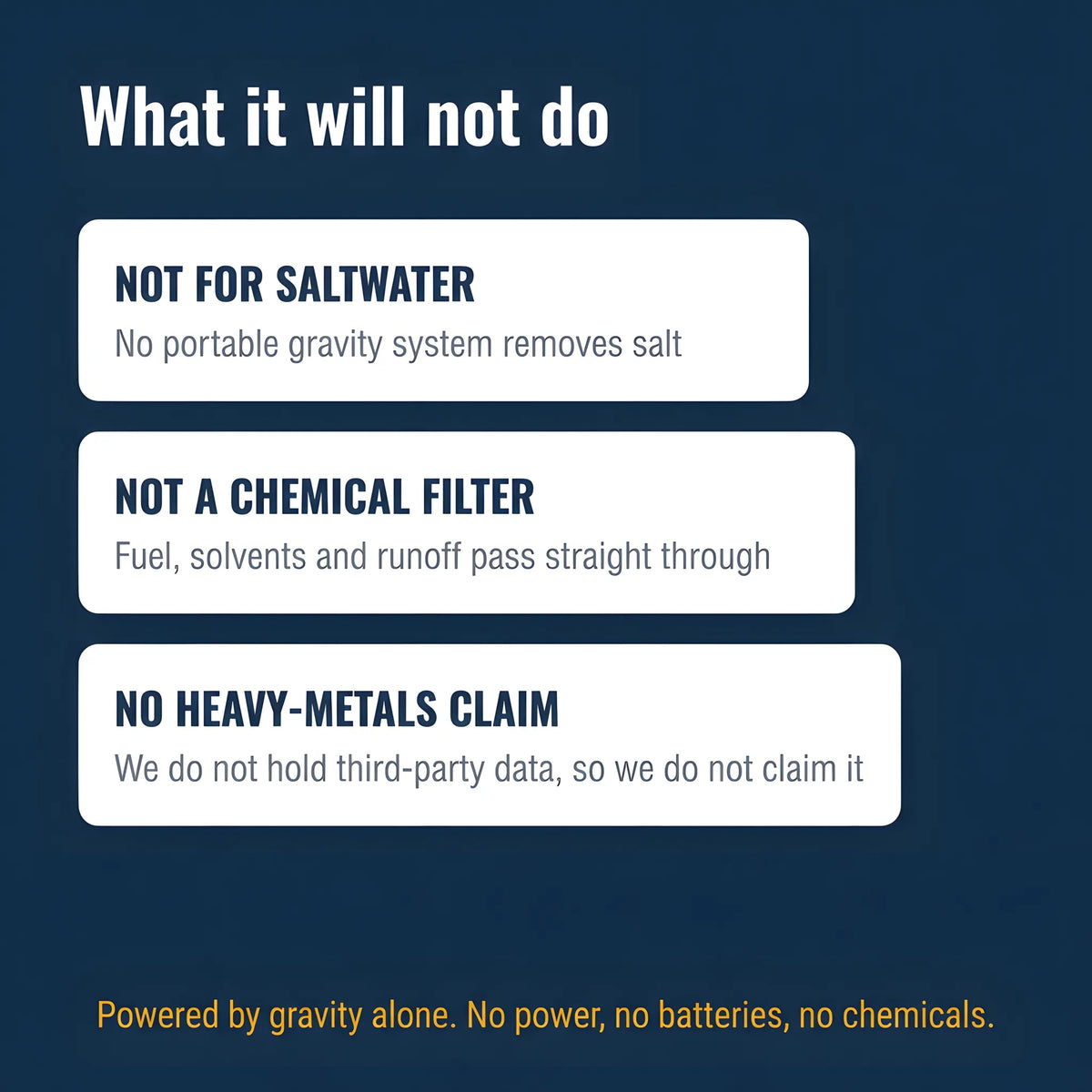
The G1 is built for natural freshwater. It is not built for saltwater, and it will not make seawater drinkable. It is not a chemical filter — do not run water you suspect contains fuel, industrial runoff, solvents, or agricultural chemicals through it. We do not publish a heavy-metals claim, because we do not have third-party heavy-metals data for this core, and we would rather tell you that than imply otherwise.
The core is rated for 4,000 liters, not forever. Filter life depends on how dirty your source water is — silty water will shorten it, and backflushing after use will extend it.
One hard rule: never let the core freeze while it is wet. Ice will rupture the hollow fibers and the filter will be finished. Dry it fully before it goes anywhere that drops below freezing.
BEFORE YOU BUY
Frequently Asked Questions
How does the CLEARDRAW G1 actually work?
How does the CLEARDRAW G1 actually work?
It is gravity-fed, so there is nothing to power or pump. Fill the 1-gallon reservoir from any freshwater source, clip the strap to something above your container, and gravity pulls the water down through the 0.01-micron core and out the hose as drinking water. Set it up and walk away while it runs.
What does the 0.01 micron rating mean in practice?
What does the 0.01 micron rating mean in practice?
Micron rating is the size of the pores in the membrane — smaller pores stop smaller things. Most portable filters in this category use 0.1 micron. The G1's core is 0.01 micron, ten times finer, with a 1-micron PP cotton pre-layer that catches sediment first so the membrane lasts longer.
How long does the filter core last?
How long does the filter core last?
It is rated for 4,000 liters, which is about 1,057 US gallons. Real-world life depends on your source water — silty or muddy water will shorten it, and backflushing when the flow slows will extend it. Sealed and stored at room temperature, an unused core has a five-year shelf life.
What water can I use it with, and what should I avoid?
What water can I use it with, and what should I avoid?
Creeks, rivers, lakes, ponds, and collected rainwater are all fine. Fill from the clearest water available for the best flow and the longest core life. Do not use it on saltwater, and do not run water you suspect contains fuel, solvents, industrial runoff, or agricultural chemicals — this is a physical filter, not a chemical one.
How do I store it, and can it freeze?
How do I store it, and can it freeze?
Backflush with clean water when the flow slows, then let everything air-dry fully before it goes into the pouch. Never let the core freeze while it is wet — ice ruptures the hollow fibers and ruins the filter permanently. Dry it completely before storing it anywhere that drops below freezing.